Soffit and fascia repair in Woodstock, by people who know these rooflines
Soffit and fascia repair in Woodstock, GA runs $8 to $22 a foot installed, with a $250 to $400 minimum on small jobs. Free quote from a local crew.
Free quotes, usually the same day. Tell us what you are looking at and we pass it straight to a local crew.
Why people in Woodstock call about this
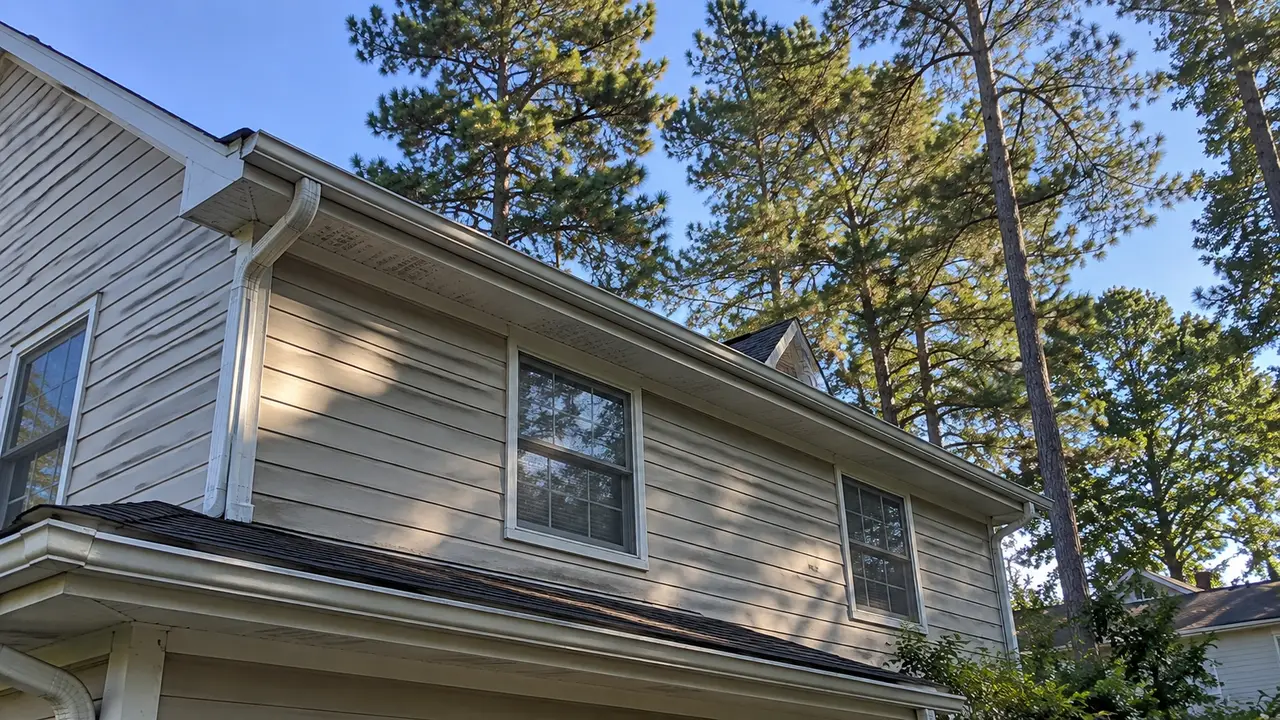
Usually one of four things has happened. A gutter has started to sag or pull away at one end. A soffit panel under the overhang has gone soft, stained or dropped out of line. A woodpecker has opened up a board and keeps coming back to the same spot. Or a home inspection has come back with a line about rotten trim and a sale is waiting on it.
All four are the same underlying problem: the edge of the roof is the wettest, least inspected part of the house, and in this county it is under trees. The fascia is the board the gutters bolt to, the soffit is the panel underneath the overhang, and between them they are doing more work than anything else on the outside of the building.
What we do is straightforward. Tell us what you are looking at and we pass it to a crew that works Woodstock and the rest of Cherokee County regularly. We are not a contractor and we do not do the work, which is exactly why we can tell you when the honest answer is that you do not need to hire anyone.
What it costs around here
Crews locally quote 8 to 22 dollars per linear foot, with a minimum of 250 to 400 dollars to turn up at all. These are local market ranges gathered in 2026, not a quote.
| Size | Typical | Range |
|---|---|---|
| One section a single bad stretch of fascia behind one gutter run | 12 linear feet | $250 to $400 |
| One elevation, single story the back of a ranch, or one side of a split level | 40 linear feet | $320 to $880 |
| Front elevation, two story the street face of a typical Towne Lake two story | 60 linear feet | $480 to $1320 |
| Whole roofline, single story all four sides of a ranch, fascia and soffit together | 130 linear feet | $1040 to $2860 |
| Whole roofline, two story a standard nineties subdivision house, all elevations | 190 linear feet | $1520 to $4180 |
| Whole roofline with dormers dormers, a bay and a wrapped porch add length fast | 240 linear feet | $1920 to $5280 |
Every crew prices the job in front of them. Access and site conditions move the number more than size does, so treat this as the ballpark to expect, then get a real quote.
The part nobody tells you: it rots behind the gutter
Woodstock subdivisions were cut out of standing loblolly pine and the builders left as many trees as the plans allowed. That is why people bought the houses, and it is also why the gutters here fill about twice as fast as any national maintenance advice assumes.
Pine needles do not wash through a gutter the way leaves eventually do. They weave into a dense mat that holds water and pushes the standing level up above the back lip of the trough. Water over that lip spills down between the gutter and the fascia board, onto the strip of wood the gutter covers. That strip was painted once, before the gutters went up, and never since, because nobody takes gutters down to repaint a house. It soaks in, and because the board is sandwiched against metal it never dries out.
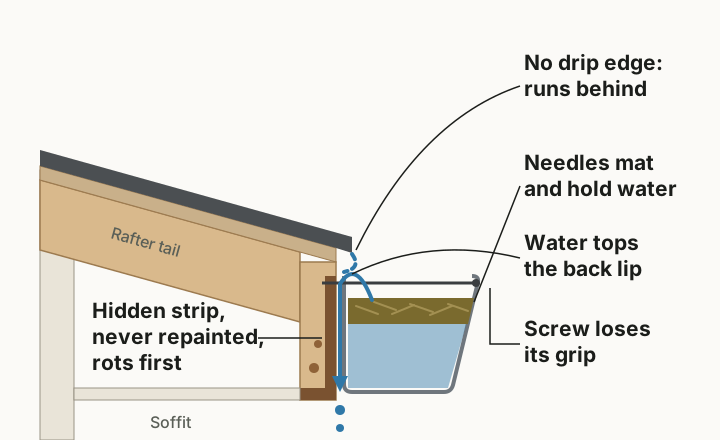
So by the time anything is visible from the ground, the board has been wet for two or three seasons. The first symptom is almost never a stain. It is the gutter beginning to tilt or sag, because the screws holding it are no longer biting into solid wood. If you only do one thing after reading this page, go sight down each gutter run the way you would sight down a plank. A sound one is dead straight.
How soffit and fascia repair works in Woodstock
You call, and we ask four things: which side of the house the damage is on, whether that side is one story or two, roughly how many feet of trim look wrong, and about when the house was built. Around Woodstock the build year mostly tells a crew whether the trim is original hardboard or real wood, and that decides whether a soft spot can be patched or the whole board has to come off.
On the day, the gutter on the bad run comes down first, because the rot is almost always on the strip of board it was hiding. The crew sounds the wood with a screwdriver, cuts back to solid board on both sides, and checks the rafter tails behind it before anything new goes up. Sound framing gets a new fascia board, usually fiber cement or primed wood, and any soffit panel that has sagged or soaked through is replaced or reset on the same pass.
Then the gutter goes back up on new hangers driven into fresh wood, pitched so it drains toward the downspout instead of pooling against the back lip, and the new trim is primed and painted on every face, including the back that the gutter covers. A single run on a one-story elevation is usually a one-day job. Rafter damage found once the old board is off is the one thing that changes the plan, so ask for a rate on it before work starts.
What we can get you quoted
- Fascia board repair and replacement Fascia board repair in Woodstock runs $8 to $22 a foot installed. When a section repair is enough, when the run has to come off, and what moves the price.
- Soffit repair and replacement Soffit repair in Woodstock, GA: stained or sagging panels, what caused it, and why replacing the panel without finding the leak wastes the money.
- Rotted fascia behind gutters The fascia rot you cannot see: how pine needles in a Woodstock gutter destroy the board behind it, and how to check yours before the gutter falls.
- Woodpecker hole repair Woodpecker holes in fascia around Woodstock are usually a carpenter bee problem. Fixing the board without the bees means the birds come back next spring.
- Hardboard and Masonite trim Most Woodstock houses built from 1985 to 2000 were trimmed in hardboard. Here is how it fails, how to recognize it, and what is worth putting back.
- Soffit vents and attic airflow Blocked soffit vents cook a Georgia attic and shorten the roof above it. What the vents do, how they get blocked, and what fixing them involves.
- Storm damage roofline repair Wind and limb damage to soffit and fascia in Cherokee County: what to do first, what insurance usually covers, and how to avoid the storm-chaser crews.
- Aluminum fascia wrap Wrapping fascia in aluminum ends the painting, but only if the wood underneath is sound. How to tell whether a wrap is an upgrade or a cover-up.
- Exterior wood rot repair Rotted exterior wood on a Woodstock house: where it starts, how to tell how far it has gone, and what it costs to put right.
Neighborhoods we cover
We pass jobs to crews who work Cherokee County regularly, which matters more than it sounds. Conditions vary between properties a few streets apart, and a crew that knows the neighborhood quotes it right the first time.
Soffit and fascia repair around Woodstock
Woodstock itself is the 30188 and 30189 ZIP codes, but the crews we pass jobs to cover the towns around it too, and the trim problems change as you go. Canton splits between real wood near the square and hardboard in the newer subdivisions. Kennesaw is mostly 1990s hardboard now reaching the age where it fails. Acworth rooflines on Lake Allatoona age faster in the damp lake air, and Holly Springs has new houses under old trees that drop straight into the gutters. Out in Ball Ground the barn and outbuildings often need the same work as the house, and the older wood trim in Roswell draws carpenter bees and the woodpeckers that follow them. Each town has its own page.
Soffit and fascia questions from Woodstock homeowners
What does soffit and fascia repair cost in Woodstock?
Most repairs land between 8 and 22 dollars per linear foot installed, with the material and the height of the elevation deciding where in that range you fall. Small jobs are governed by the minimum charge rather than the footage: nearly every crew has a floor of roughly 250 to 400 dollars for a callout, because the setup and the ladder are most of the work on a short run.
Why is there a minimum fee for a small repair?
Because the drive, the ladder or staging, the gutter coming down and going back up, and the paint are the same whether the run is four feet or fourteen. A crew that charged strictly by the foot would lose money on every small job and would simply stop taking them. If you have more than one small repair, having them done in the same visit is much cheaper than two callouts.
How do I measure my roofline to get a rough price?
Measure along the ground below each run of gutter and add the runs together, which is close enough for an estimate. A typical single-story Woodstock house has roughly 120 to 150 linear feet of fascia, and a two-story with dormers runs 180 to 250. You only need to measure the sections that have actually failed, not the whole house.
Why does fascia rot so quickly in this part of Cherokee County?
Because the subdivisions were cut out of standing loblolly pine and the builders left as many trees as the plans allowed. Pine needles mat in the gutters rather than washing through, the standing water rises above the back lip, and it spills down the strip of fascia hidden behind the gutter, which is the one part of the board that never gets repainted. Heavy tree cover also keeps the roofline from drying between storms.
My house was built in the nineties. What is my trim made of?
Almost certainly hardboard, which was the standard exterior trim across the southeast from around 1985 to 2000 and covers most of the Towne Lake area. It is compressed wood fiber with a factory primer. It fails by swelling and delaminating at the bottom edge and at butt joints once the paint film cracks, which looks quite different from the way real wood rots.
Is it cheaper to repair a section or replace the whole run?
A section is cheaper if the rest of the run is genuinely sound, and a competent crew will scarf the joint over a rafter so the repair is invisible from the ground. If two or three sections along one elevation have gone, replacing the run usually costs less per foot and avoids paying for the setup twice. Ask for both numbers.
Do I need a licensed contractor for this work in Georgia?
Georgia requires a residential contractor license for any single project over 2,500 dollars including both labor and materials. A section repair generally falls below that; a full roofline in fiber cement generally does not. It is a fair question to ask at the estimate, because a job that starts as a few boards and turns into re-decking crosses the line quickly.
Can I just wrap the fascia in aluminum instead of replacing it?
Only over sound wood. Wrapping ends the painting and keeps carpenter bees out, which is a real upgrade. Over rotten board it is worse than doing nothing, because the metal seals moisture in and removes the drying that was slowing the rot down. Ask the estimator to probe the wood with an awl in front of you before agreeing to a wrap.
Woodpeckers keep attacking the same board. What do I do?
Treat the carpenter bees, not the birds. The woodpeckers are after larvae in tunnels the bees drilled, which is why it recurs in the same place each spring. Fill the holes with exterior epoxy filler rather than caulk, do it in late summer or early spring rather than May, and paint the board afterwards, because bare softwood is what attracted the bees in the first place.
How quickly can somebody get out to look at it?
Most quotes come back the same day or the next morning. Scheduling the work is usually within a week or two, and the exception is storm damage, where an open soffit means an open attic and it moves to the front of the line. Spring and fall are the busy seasons here because that is when the paint goes on best.
Free quotes, usually the same day. Tell us what you are looking at and we pass it straight to a local crew.