Sagging gutters are almost never a gutter problem
Sagging or detaching gutters are usually a fascia problem, not a gutter problem. Rehanging them on rotten board is money spent twice.
Free quotes, usually the same day. Tell us what you are looking at and we pass it straight to a local crew.
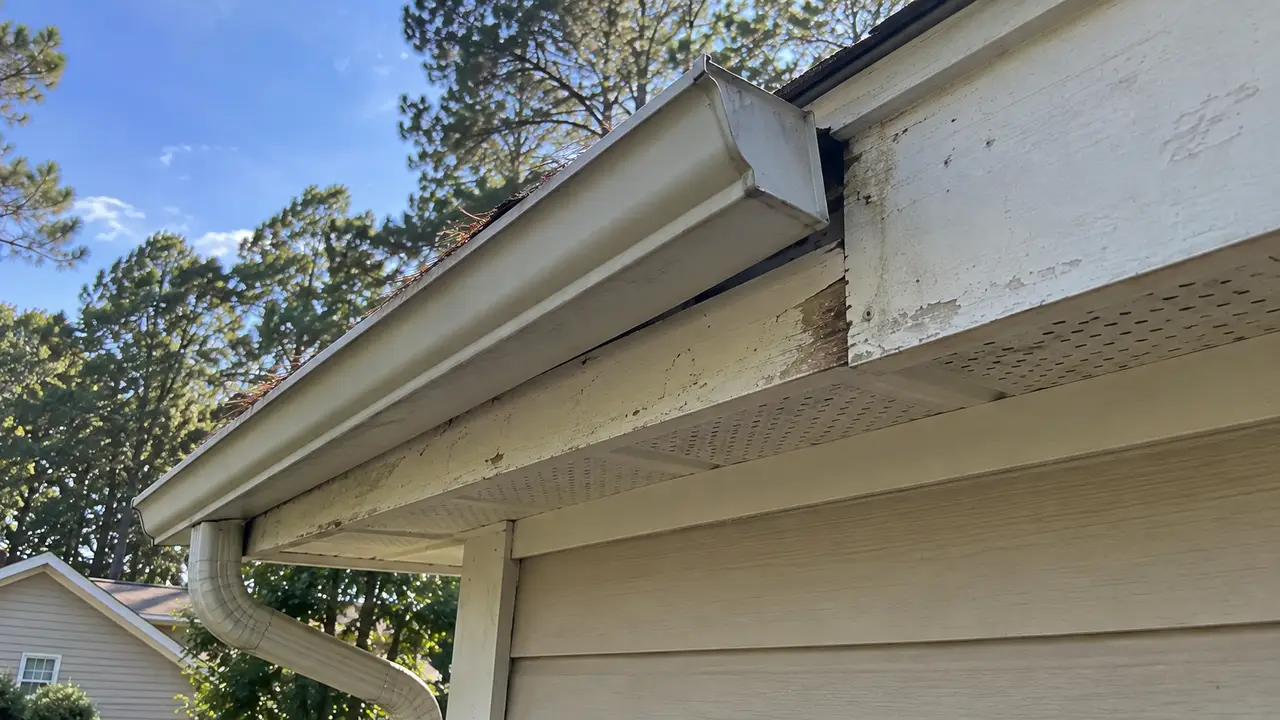
The gutter is pulling away from the house at one end, or there is a dip in the middle of a run where water now stands. The instinct is to call a gutter company. Quite often that is the wrong first call, and the reason is worth understanding before you spend anything.
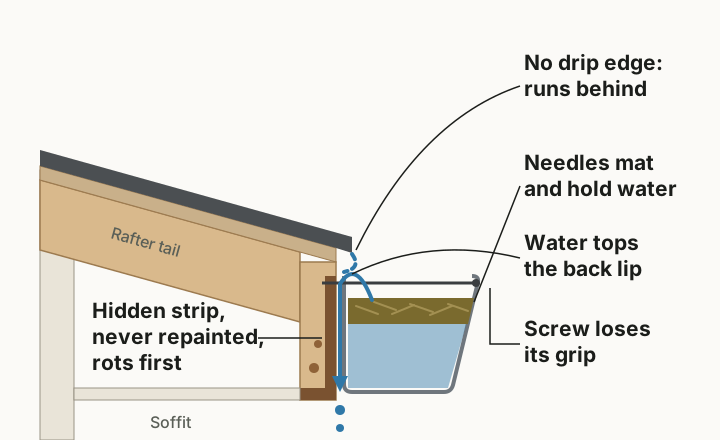
A gutter is only as good as what it is screwed to. Modern gutters hang on hidden hangers driven through the back of the trough and into the fascia board. That board is the entire structural attachment. If the wood has gone soft, the screws have nothing to grip, and no amount of rehanging or adding hangers will hold, because the failure is in the material and not the fixing.
This is why gutter companies sometimes rehang a run, take payment, and are back within a year. It is not always a scam. It is frequently a crew doing exactly what was asked without probing the board first.
The circular bit that makes this a Woodstock problem specifically. The usual reason the fascia went soft in the first place is the gutter above it overflowing. Loblolly pine needles mat in the trough, the standing water rises above the back lip, and it spills down the strip of board hidden behind the gutter, which never gets repainted because nobody takes gutters down to paint a house. So the gutter rots the fascia, and then the rotten fascia drops the gutter. Both halves have to be dealt with or the cycle simply starts over.
Work out which one you have. Push a screwdriver into the fascia just below the gutter line, at the end that has pulled away. If it goes in easily, this is carpentry and the gutter is a passenger. If the wood is hard and the problem is confined to one hanger that has backed out, or a run with too few hangers, that genuinely is a gutter job and a cheap one.
The other causes, in order of how often they turn up. Too few hangers, which should be no more than about three feet apart and closer under heavy tree cover. Hangers driven into the gap between rafter tails rather than into solid framing. Ice, which is rare here but not unknown in a hard January. And simple weight: a forty-foot run packed with wet pine needles is carrying a surprising amount, and that load is what finds the weakness.
The right sequence, if the board has gone. Gutter comes down. Rotten fascia comes off. What is behind it gets inspected, because rafter tails that have been wet for years need attention before anything new goes on. New board goes up primed on all six faces including the back. A gutter apron goes in, which is a strip of flashing that tucks under the shingle edge and over the back of the gutter so overflow physically cannot reach the board again. Then the gutter goes back on new hangers.
That apron is the detail that decides whether this recurs. It costs very little as part of a job that already has the gutter down, and it is the single most effective thing available against the exact failure mode this town has.
Then deal with the debris, honestly. If there is mature pine over the roofline, cleaning twice a year is the minimum and three times is more realistic. Standard gutter screens do not solve it: pine needles are narrower than the mesh and go straight through, then mat on the underside where they cannot be cleared. Micro-mesh guards do work under pine and cost accordingly. Anything coarser is decoration, and being sold a coarse screen as a solution to a pine needle problem is the most common bad purchase in this niche.
One genuinely free option: if the tree over that run can be limbed back, that is the cheapest long-term fix available and it also addresses the shade that keeps the board from drying. It is worth pricing tree work against gutter guards before assuming the guards are the answer.
More like this
- Why Woodpeckers Are Drilling Your Fascia
- How to Tell if Your Fascia Is Rotted
- Wood, Hardboard, PVC or Fiber Cement?
- Soffit and Fascia: What to Fix Yourself
- How Animals Get Into Your Attic
- When Fascia Repair Becomes a Roof Job
- Rotted Wood Behind Your Gutters: What It Costs
- Water Runs Behind the Gutter Instead of Into It
Services
When the board needs fixing rather than reading about, the soffit and fascia repair in Woodstock, GA page covers what a repair visit looks like and what it costs.
Common questions
Can I just put in longer screws?
For a season, maybe. A longer screw driven into soft wood has nothing more to grip than the short one did, because the problem is the board rather than the fastener. If the wood behind the hanger is sound, new hangers are a real fix. If it is not, you are pinning a gutter to something that is failing.
Why does fascia rot so quickly in this part of Cherokee County?
Because the subdivisions were cut out of standing loblolly pine and the builders left as many trees as the plans allowed. Pine needles mat in the gutters rather than washing through, the standing water rises above the back lip, and it spills down the strip of fascia hidden behind the gutter, which is the one part of the board that never gets repainted. Heavy tree cover also keeps the roofline from drying between storms.
My house was built in the nineties. What is my trim made of?
Almost certainly hardboard, which was the standard exterior trim across the southeast from around 1985 to 2000 and covers most of the Towne Lake area. It is compressed wood fiber with a factory primer. It fails by swelling and delaminating at the bottom edge and at butt joints once the paint film cracks, which looks quite different from the way real wood rots.
Is it cheaper to repair a section or replace the whole run?
A section is cheaper if the rest of the run is genuinely sound, and a competent crew will scarf the joint over a rafter so the repair is invisible from the ground. If two or three sections along one elevation have gone, replacing the run usually costs less per foot and avoids paying for the setup twice. Ask for both numbers.
Free quotes, usually the same day. Tell us what you are looking at and we pass it straight to a local crew.